
A Bough in the Strong Wind
Headland Changes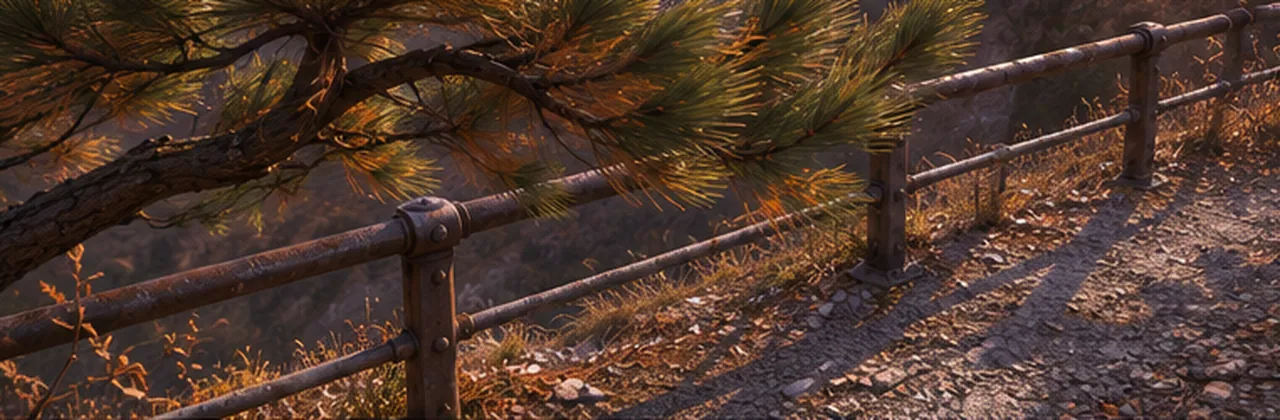
Put the moving branch over a fixed rail
A pine above the near path leans toward the sea. As wind lifts one end, the lower needles travel across the view of a dark post. In our earliest prototype the whole canopy moved backward during a gust and then returned. The movement seemed to pull the rail with it for a moment. A person trying to look for the next turn could miss the one part of the scene that had remained steady.
Give the tree more than one scale of movement
The thick portion of the bough now moves a little while the ends travel farther. The farthest needles become sharp against the sky before moving into the darker rock. A longer part of the tree stays close to the trunk. That difference gives the ranger a rough sense of where the branch is attached even when the end passes across the short view of the fence. The connection to the trunk remains for almost the whole watch.
Keep a quiet mark at the base of the post
Early testing put a bright line along the whole top of the rail. In the new view the brightest area is a small worn patch near the foot of a post. It stays in view just below the lowest needles when they cross the path. From the far side, a strip of dark iron beside the post shows the same height off the ground. This place gives enough of the rail to trace before more of the view comes back.
Follow the breeze into the wider frame
The ship below the headland moves slowly in a clearer area of water. Its pace looks very different from the movement of the far end of the bough. In Anchor on the Pine Side the ranger can move back to a place with both the bough and the sea below in view. Find the boat in the gap between the branches. If the narrow side of the rail is still understandable there, the path can be located after the wing of the tree comes back across it.
Let a branch shadow remain readable on gravel
The blurred part of the shadow travels along the ground before the strongest wind reaches the tip. A little dry gravel near the path holds a sharp diagonal. The dark areas under the pines remain almost unchanged. With fewer moving details, the first two shapes can make a useful comparison. The distance from the worn post can stay fixed even as the darkest part of the moving shadow seems to lengthen across the ground.
Watch sound without asking it to carry the whole view
The branches have a light rushing sound and a few sharper taps. When a stronger patch of surf becomes audible at the same time it can seem as if everything around the ranger is moving faster. The Surf Sounds Closer checks the mismatch at a wider scale. Here the fixed top of the lower fence and patch of gravel remain visible when both sounds reach their peak.
Keep the quiet portion beside a longer gust
A longer version of the movement can leave the nearest pine end out of view for several seconds. With the lower mark still visible, the path offers a place to wait. Someone who starts watching midway through a gust can compare the dark post and the part of the tree nearest the trunk. They can then recognize the tips by the way they move back into the image rather than needing to watch the branch from the beginning.
Keep the earlier silhouette available
Headland Changes pairs the first broad movement with the current smaller changes to the tree. Use the pair beside the path picture from the lower view. An upcoming scene may put the strongest wind above a different rail, several paces away. Preserve a steady thing low in the picture so the new movement can be read in relation to a fixed part of the coast.